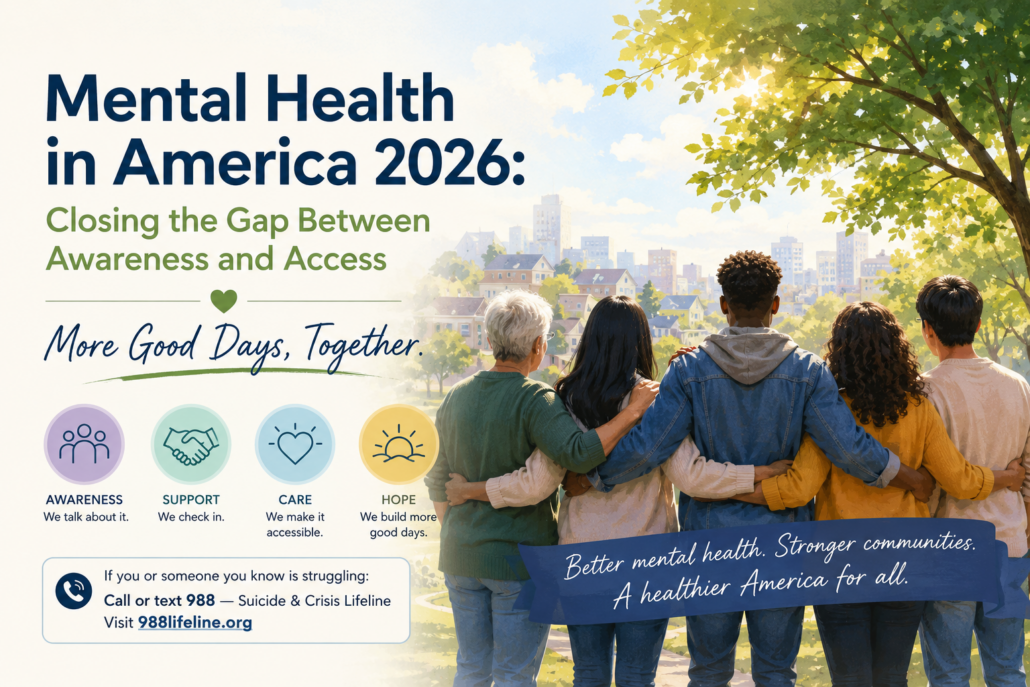
More Good Days, Together — that’s the theme guiding this year’s national conversation on mental health, and it captures a shift happening across the country. Conversations that once felt taboo now happen openly in workplaces, schools, and family group chats. But awareness alone isn’t the goal anymore — the real challenge now is closing the gap between people who need support and people who actually receive it.
The Scale of the Issue
The numbers make clear why this matters. Roughly 59.3 million people — about 23% of the U.S. adult population — currently live with a mental illness, according to the National Institute of Mental Health. About 6% of adults experience serious mental illness, meaning a condition that substantially interferes with major life activities.
Despite growing awareness, access to care hasn’t kept pace. One in four adults with a mental illness reported an unmet need for treatment in 2022–2023, and more than 5 million adults with a mental illness were uninsured during that same period. Separately, nearly 30 million people across the U.S. still lack access to affordable, comprehensive mental health and substance use treatment. Revive Research
The consequences of that gap are serious. Suicide remains one of the leading causes of death in the United States, with nearly 46,000 deaths reported in 2020 and over 1.8 million suicide attempts among adults and adolescents combined. Notably, nearly half of individuals who die by suicide have a known mental health condition.
A Movement Nearly 80 Years in the Making
Mental Health America founded Mental Health Awareness Month in 1949, and has led the observance every May since — 2026 marks its 77th year. What started as a niche public health effort has become one of the most visible national campaigns in the country, reaching workplaces, schools, and families nationwide.
But observers note the mission has evolved. The mental health workforce shortage in the U.S. is well documented — many people who recognize they need support can’t find a therapist with availability, in their network, or affordable to them. People in rural areas, communities of color, and LGBTQ+ communities often face additional barriers. As a result, this year’s push centers on expanded access, fair reimbursement, and integrating mental health into primary care, schools, and workplaces — not just raising awareness.
Why This Moment Feels Different
The mental health landscape today looks quite different from even five years ago — more people are talking about it, but access to care still has a long way to go, with the effects of the COVID-19 pandemic leaving a lasting mark on well-being nationwide. At the same time, 2026 has brought growing awareness and rapid innovation, with advances in neuroscience and emerging treatment approaches beginning to make care more accessible and personalized.
The Bigger Picture
Mental health conditions affect people of all ages, backgrounds, and income levels — which is exactly why this conversation matters to nearly everyone, not just those in crisis. Whether the goal is supporting a coworker, checking in on a friend, or simply understanding your own mental health better, the throughline across this year’s national campaigns is the same: awareness is the starting point, not the finish line.
If you or someone you know is struggling:
📞 Call or text 988 — the Suicide & Crisis Lifeline
🌐 Visit 988lifeline.org