
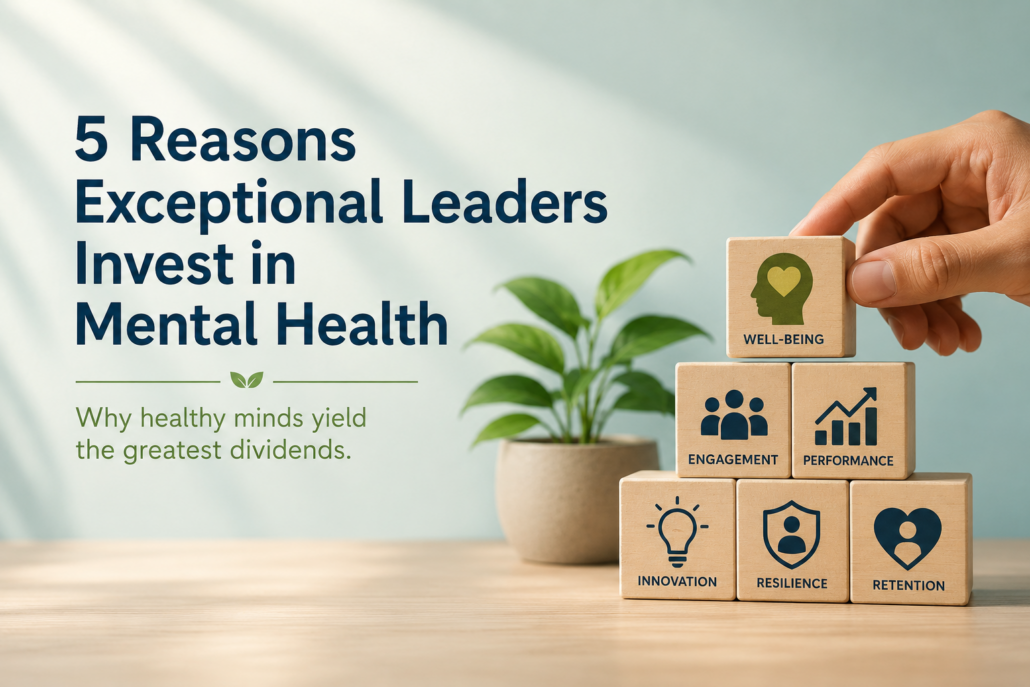
Why healthy minds yield the greatest dividends By Sheila Robinson-Kiss MSW, LCSW
I took an economics class in college where my professor said something that’s stuck with me: think strategically, because every action has a consequence, every choice has a cost, and everything is connected. That lesson applies just as much to leadership as it does to economics.
The best leaders understand that employee mental health isn’t an isolated HR issue — it’s connected to decision-making, innovation, engagement, retention, and ultimately the financial health of the company. Employees need to be well before they can perform well.
Healthy minds solve problems more effectively, communicate more clearly, and make better decisions under pressure. Chronic stress, on the other hand, quietly erodes concentration, judgment, and motivation.
The financial stakes are real: according to Deloitte, mental health inequities cost U.S. businesses roughly $115 billion a year through absenteeism and attrition.
Throughout my career as a psychotherapist and leadership trainer, I’ve worked with some of the most respected leaders across industries. The exceptional ones all share one trait: they treat employee mental health as a strategic asset — not a buzzword.
One pharmaceutical executive told me every new hire submits a personal self-care plan and schedules vacation time well in advance, because balance is part of the company’s mission and performance standards.
That’s backed by neuroscience: the brain isn’t built for nonstop output. Peak performance requires real recovery — we can’t run our lives like we run our phones, without ever unplugging.
According to NAMI, 53% of employees report feeling burned out, and 35% say their mental health has hurt their job performance. Behind those numbers are real people — like one woman in a wellness focus group who admitted she was functioning at only 5–10% of her potential while raising three kids alone, all while performing detailed work with toxic chemicals. Her story reflects a growing group of “functionally, chronically stressed” employees — outwardly productive, inwardly depleted.
No workplace can eliminate stress entirely, nor should it try. But exceptional leaders build cultures that strengthen resilience before stress turns into burnout.
Here are five reasons mental health is a strategic asset:
- Better decision-making — Chronic stress narrows attention and distorts risk assessment. One construction worker shared how staying mentally sharp helped him catch a coworker’s dangerous mistake with a crane load — potentially preventing a serious accident and a lawsuit.
- Stronger engagement and teamwork — Employees who feel psychologically safe are more likely to collaborate, speak up, and stay engaged. Trust fuels performance.
- Lower burnout and turnover — Burnout rarely announces itself. It creeps in through skipped lunches, late-night emails, and postponed vacations — until exhaustion becomes the culture. Great leaders interrupt that cycle early.
- More creativity and innovation — Anxiety limits the mental space needed for breakthrough thinking. Employees who feel supported take more thoughtful risks and stay more invested in the company’s success.
- Resilient, high-performing culture — Real culture shows up in what employees say when leadership isn’t in the room. Do they joke about never taking vacation, or do they say leadership actually means it when they talk about self-care?
Resilience isn’t about asking people to carry heavier loads forever — it’s giving them the tools to recover and keep going. The organizations that thrive won’t just have smart strategies. They’ll have leaders wise enough to know their greatest asset was never technology or balance sheets — it’s the health of the people carrying the mission forward.
LInk to the full article here: https://www.psychologytoday.com/us/blog/theyre-not-coming/202607/5-reasons-exceptional-leaders-invest-in-mental-health
To read more about mental health & follow AMA’s social media visit: https://www.facebook.com/asianmediaaccess/